- Vessel Solutions
- Mepaco Food Processing Equipment
- Service 360
- Contract Manufacturing
- Finishing Services
- Transport
- Resources
Stainless steel earns its reputation for corrosion resistance, but the fabrication process often causes need for additional corrosion protection. Cutting, forming, grinding and welding can leave free iron on the surface, along with heat tint and scale. Picking, passivating and electropolishing are three finishing processes that restore and improve stainless performance. These finishing processes are used in equipment and components headed to food processing, pharmaceutical, biotech or other sanitary facilities.
Part of this comparison criteria includes surface roughness. RA, or roughness average, is the most common measure of surface texture. It is the average height of the microscopic peaks and valleys on a surface; measured with a profilometer and reported in microinches. A lower Ra number means a smoother surface. Low Ra surfaces are easier to clean because there are fewer places for residue and bacteria to attach.
Passivation: Cleaning the Surface Chemically
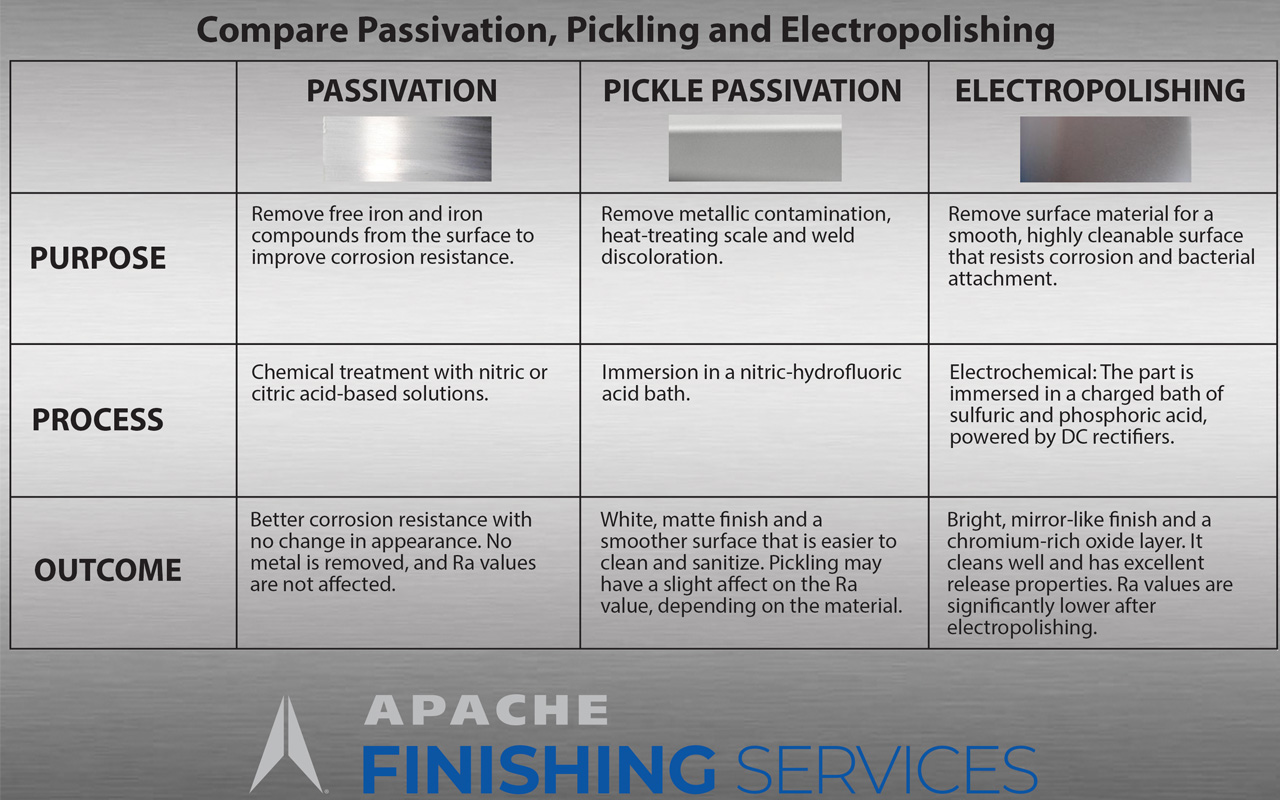
Passivation is a chemical process that removes free iron and iron compounds from the surface of stainless steel using nitric or citric acid-based solutions. Its purpose is to improve corrosion resistance. Because no metal is removed, passivation has little effect on surface roughness (Ra) and does not change the appearance of the part. ASTM A967 is the federal standard that covers the cleaning, passivation and testing of stainless parts and components.
Pickling: Removing Scale and Heat Tint
Pickle passivation goes a step further. The part or component is immersed in a nitric-hydrofluoric acid bath that removes metallic contamination, heat-treating scale and weld discoloration. The results is a white, matte finish and a smoother surface that is easier to clean and sanitize, along with enhanced corrosion resistance. While it is a different process, it falls under the ASTM A967 spec. Pickling can modestly lower Ra by smoothing the surface.
Electropolishing: Smoothest RA Values
Electropolishing is an electrochemical process that removes a thin layer of the surface metal. The component is a immersed in a charge bath of sulfuric and phosphoric acid powered by DC rectifiers. The outcome is a smooth, bright, mirror-like finish and a chromium-rich oxide layer that enhances corrosion resistance. By dissolving microscopic peaks, it lowers Ra more than the other two processes, which is why it is specified for high-purity work.
Increased Capacity
Apache expanded its pickle passivation and electropolishing facility in 2025 and again in 2026. Our pickle passivation tanks accommodate parts up to 20 feet wide and 7 feet deep, and its electropolishing tanks handle parts up to 14.5 feet wide with heavy components moved by cranes up to 6 tons.
Why Apache
Apache performs passivation, pickle passivation and electropolishing in-house, so there is no dependency on outsourcing and your equipment stays in one controlled workflow from fabrication through finishing. Apache has offered pickling and electropolishing for decades, with a focus on high-purity applications.
Ready to talk through your finishing requirements? Contact Apache Finishing Services or download our Finishing Flyer to get started.